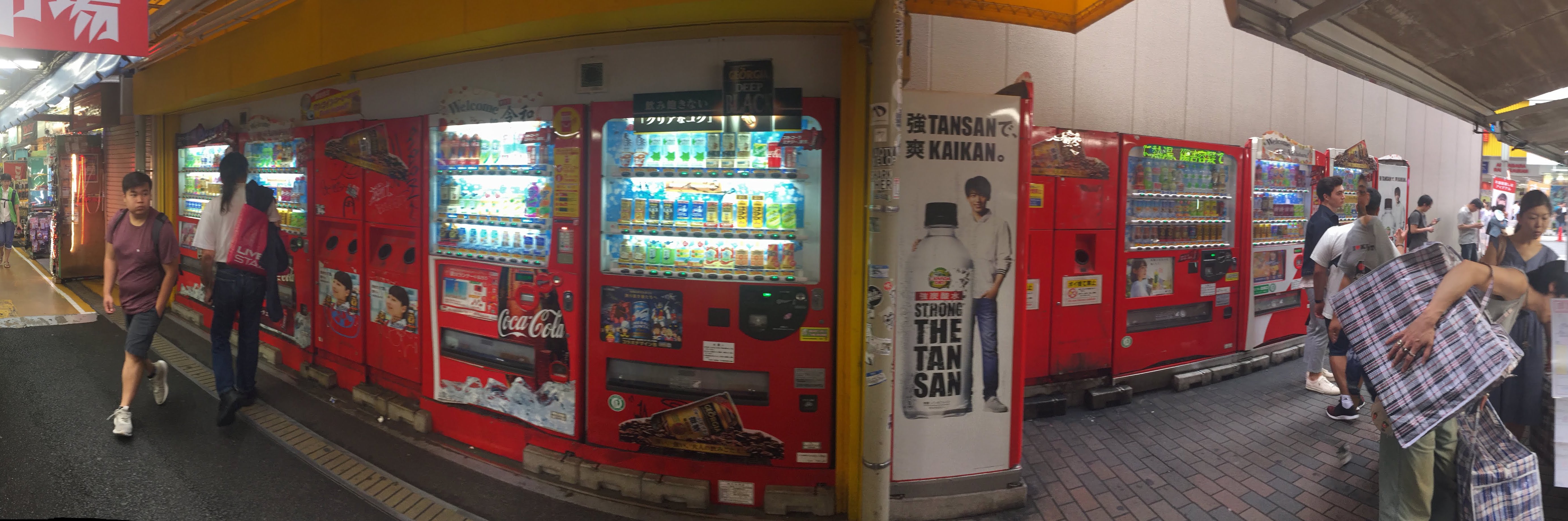
One feature of Tokyo that seems a little outlandish upon arrival is the constant presence of vending machines. Their purpose is pretty straightforward – you never need to look far to find a drink somewhere – but I find it a little bizarre nonetheless. Do the Japanese just value convenience or efficiency more than we do in the US? Is it a business strategy to save costs for business owners by allowing them to have fewer employees? Perhaps do customers prefer the experience of using a machine over the polite pleasantries of a shopkeeper?
After spending a little over a week in Tokyo I have come to the suspicion that it’s somewhat a combination of all of these, in addition to the fact that Japan has a much higher average population density than the US.
Particularly as a foreigner who speaks almost no Japanese, I can certainly say they have been tremendously convenient – but not only because of the language barrier. In fact, the question I more so have now is, “why aren’t these so prevalent in the US?” when they clearly churn out a lot of business and offer great convenience here. The density of the machines here actually seems to increase their popularity, as pedestrians can always rely on finding a machine nearby to accommodate their thirst. Their frequency also appears to drive prices down, and the costs and offerings remain very consistent across Tokyo. The prices also closely match those found in convenience stores for the same drinks.
As it turns out, there are a few reasons, culturally, why Japan is an ideal place for the wealth of vending machines found. Urban sociologists, such as Yoshimi Shun’ya (2000) and Kitada Akihiro (2011), have reported that the development of much of Tokyo has been shaped by commuter and commercial infrastructure. The areas we’ve been visiting in Japan are good examples of the way these spaces are reflections of local ways of life, notably that they are heavy traffic areas for busy commuters and shoppers – perfect locations for vending machines.
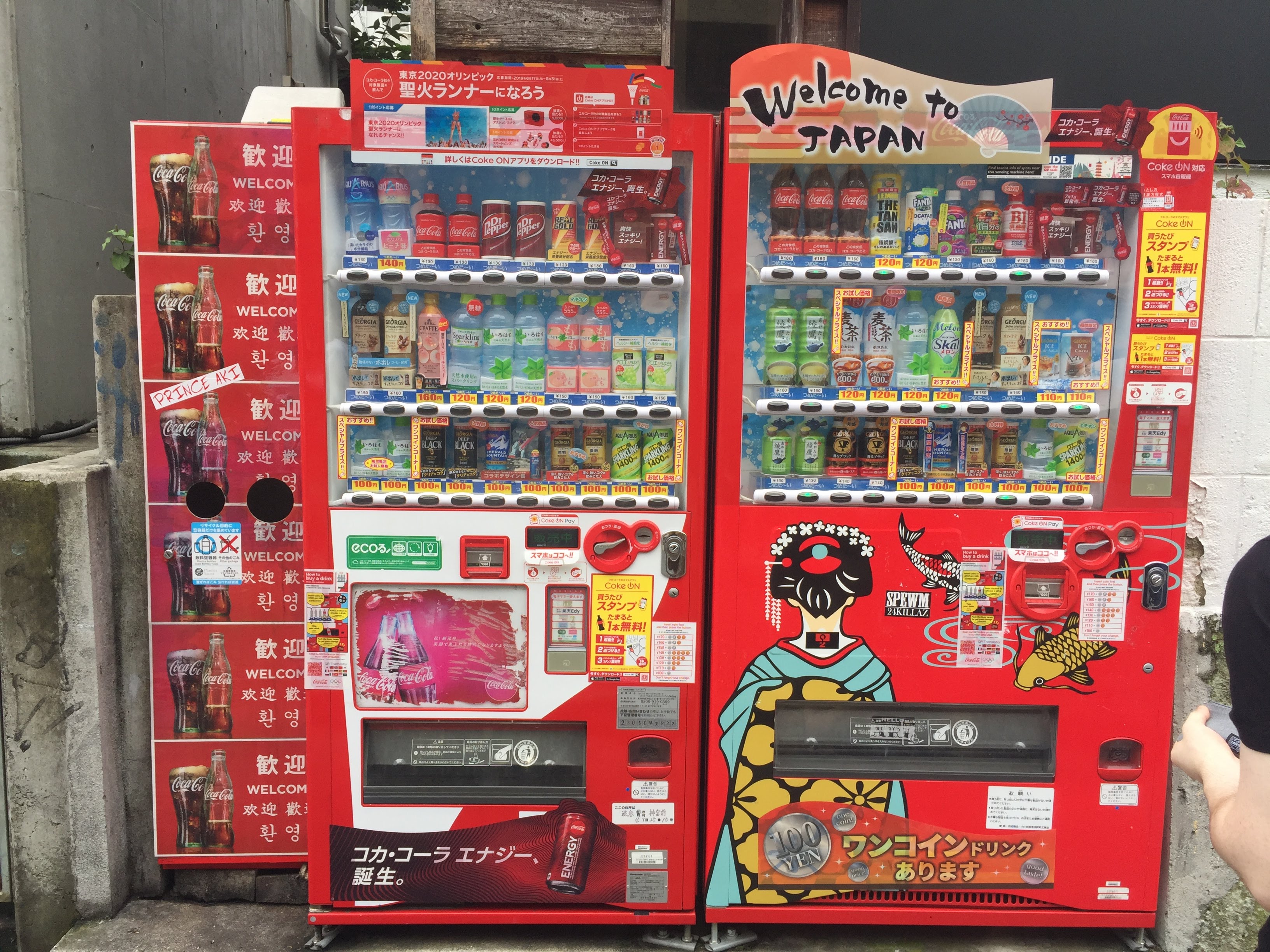
The placement of vending machines is generally chosen by local business owners. The machines typically work on a franchise-type system, where tens of thousands of yen will be used to purchase a machine that will stay in a location of your choice and provide you with services to refill the machine and a significant portion of its profits. Additionally, vandalism is a rare occurrence in Japan, and machines can be placed in even secluded areas without much fear of damage or graffiti.
From discussions I’ve had in Japan, I’ve learned that workweeks in Japan are excessive in comparison to what we experience in the US – typically a 60 hour per week minimum but sometimes reaching higher ends of 100 hours. In this context, it makes intuitive sense that these exhausted commuters want nothing more than the bare minimum amount of interaction in finding sustenance at the end of a long day. Lunch breaks typically start at noon sharp and last an hour, leaving a limited amount of time for finding food during these times as well.
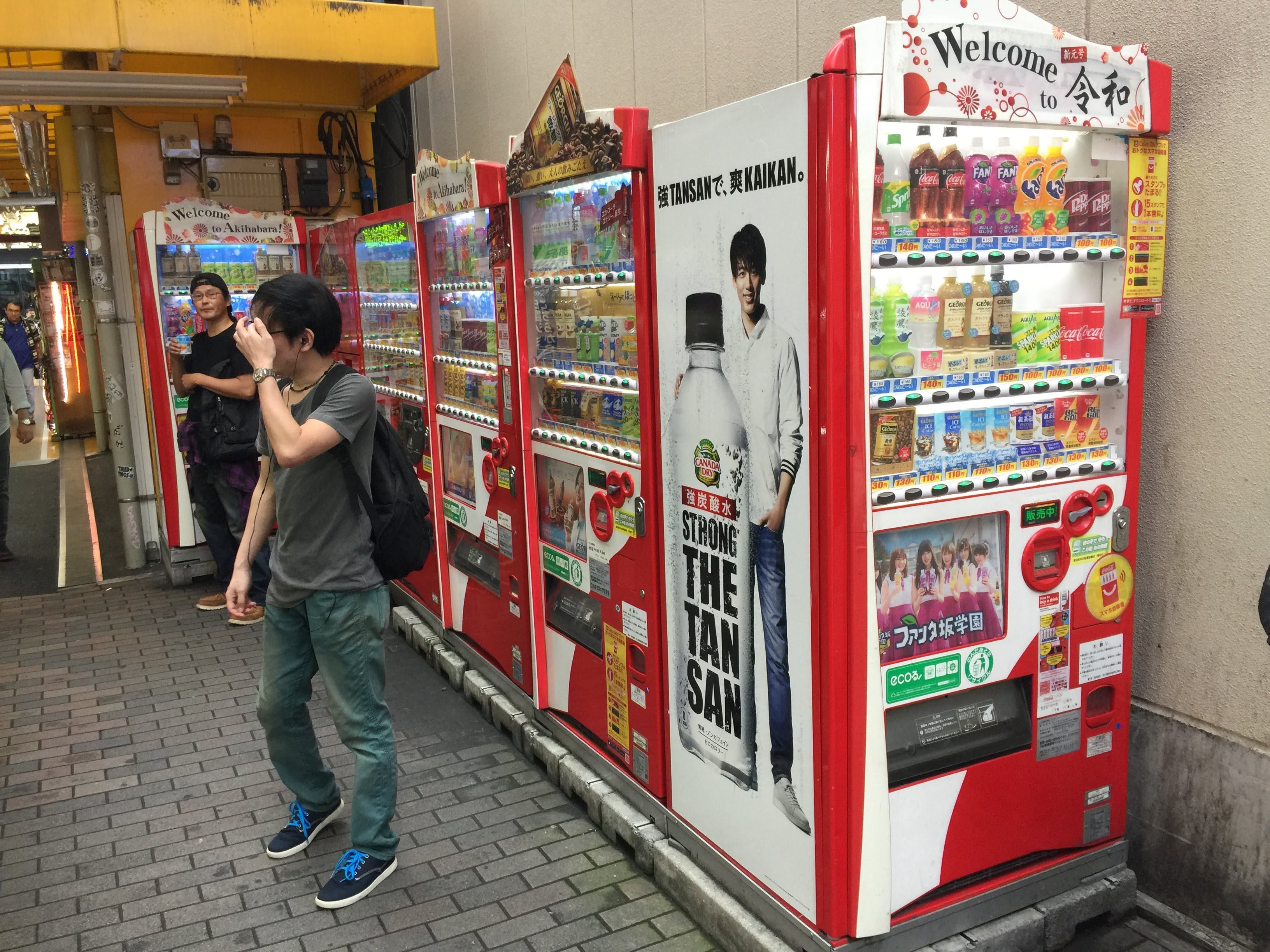
It’s customary to avoid eating or drinking while walking in Japan, and another way these machines fit neatly into Japanese culture is by being extremely space-efficient and providing an area to stand in while you enjoy your purchase. Trash receptacles, which are generally rare in Japan, are also commonly found next to the machines to provide a full conclusion to the experience.
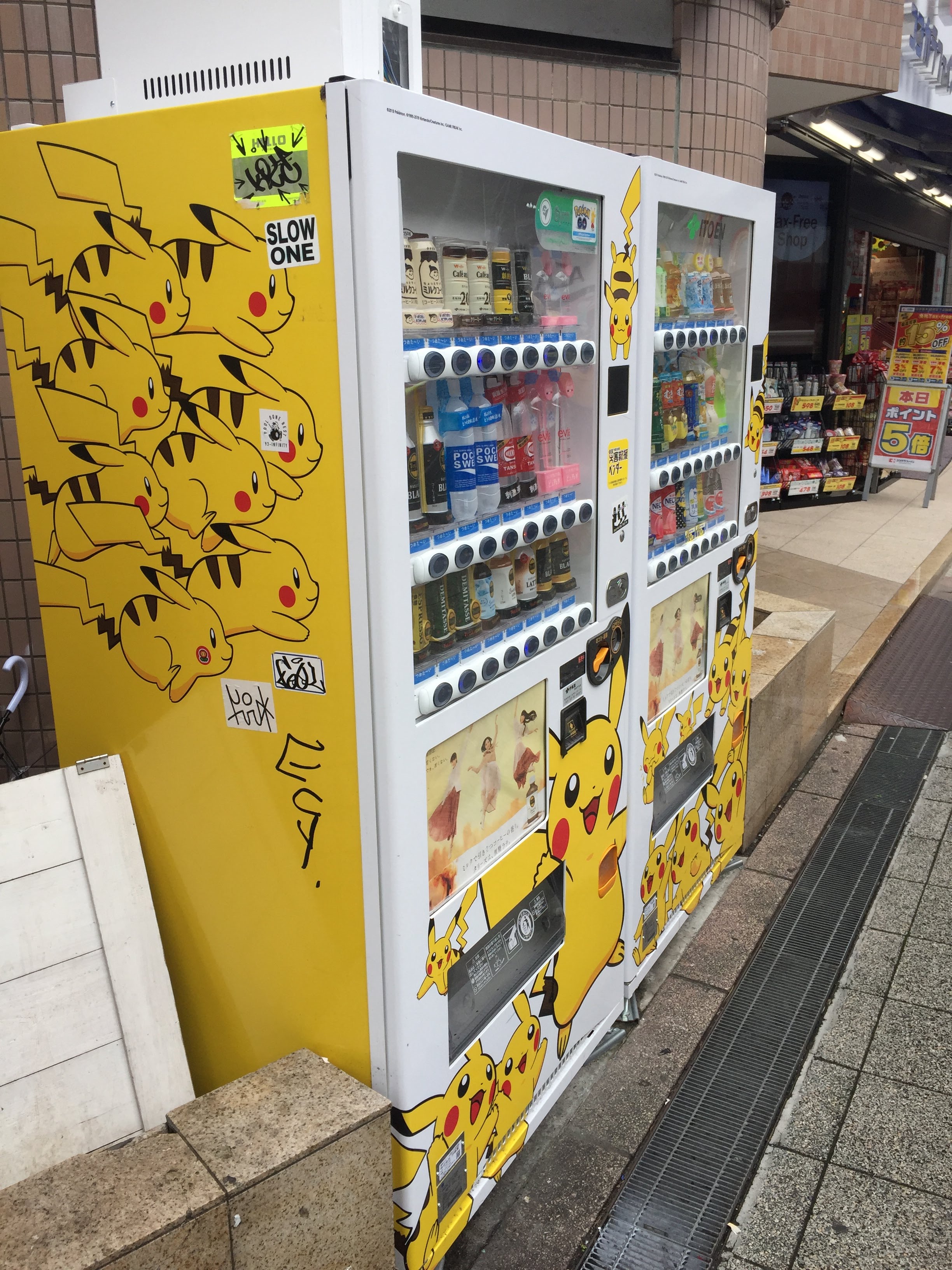
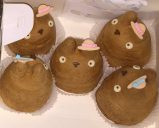
These vending machines are also perfect places to capitalize on selling a certain image or concept alongside the product itself (which are often completely unrelated, such as the adorable Pikachu drink vending machine pictured above). Machines also prominently display Coca-Cola and other American brands to incorporate an exotic feeling into what is otherwise an ordinary drink purchase.
Japan also places an emphasis on privacy, and many of the more exotic vending machines capitalize on this by offering the opportunity to buy a product where nobody can actually see your selection. More embarrassing items like otaku merchandise found in Akihabara or lingerie/condom vending machines near love hotels capitalize on this fact to increase their sales.
While I don’t think I lament the lack of lingerie machines in the US, I would love to see half as many vending machines around as one does in Tokyo. Japan, though, is definitively well-suited to the practice of placing one (or twenty) on almost every street and it’s not a mystery why the same is not true in the States.
Works Cited
Joy, Alicia. “10 Interesting Facts About Japanese Vending Machines.” Culture Trip, The Culture Trip, 24 Jan. 2017, theculturetrip.com/asia/japan/articles/10-interesting-facts-about-japanese-vending-machines/. Accessed 16 July 2019.
Live Japan. “5 Reasons Why There Are So Many Vending Machines in Japan – LIVE JAPAN.” LIVE JAPAN, 2019, livejapan.com/en/in-tokyo/in-pref-tokyo/in-tokyo_suburbs/article-a0000372/. Accessed 16 July 2019.


 Culture in Japan
Are trash cans really that common next to vending machines? I’ve only seen a few recycling bins next to vending machines on JR station platforms and don’t recall seeing too many trashcans next to the machines themselves. I might have to pay attention to that more when I go out in the next few days. While I also believe that it wouldn’t hurt to have more vending machines in the US for convenience, I do agree with the fact that the lower population density likely means it will be difficult to profit off of these machines. I guess we will never get them (except on campus).
LikeLike
I would say that they’re very common given the general rarity of trash cans in general around Tokyo. When looking for trash cans, I often look for vending machines as they’re often at least found somewhere nearby (like in the train stations).
LikeLike
I wonder what you would find in dense urban centers in the US. Whether there are a lot of vending machines in other, largely pedestrian places.
LikeLike
I wonder what you would find in a largely pedestrian urban center in the US.
LikeLike
I think the reason that the U.S has a little amount of vending machines is that most people in the U.S travel by car. While in Japan, people do more walking and public transit which give them the opportunity to place vending machines on the street, train platform, and around office buildings. Have you think about the questions that why are there many vending machines right next to convenience stores? It’s not like the vending machines sell the drink cheaper. I often find it is cheaper to buy the drink you want in a convenience store.
LikeLike
Right. You pay a premium for vending machines. Also, you will find them in the country side, sometimes at a crossroad or other strange places that you would not expect. Also don’t over estimate your experience in an urban area of Japan. Rural areas and mid-sized cities and towns are not this convenient.
I wonder, then, what you are noting about usage of these vending machines. How are people using these?
LikeLike
I feel like the contribution of the fact that Japan is a very heavily monetary country could also contribute to the mass amount of vending machines. Like for example, I find myself more prone to buying something just because I have the right amount of change in my pocket, where I would be less incline to buy if I needed to use dollar bills, and then get useless amounts of coins back, because I would have to carry around. I also feel like because of this, companies are more incline to make more vending machines knowing its so easy to attract customers.
LikeLike
Also many of the ones in urban centers now allow you to use IC cards, so you don’t even need change. I wonder how much of it is the simple psychology that says: I see the thing; I didn’t know that I wanted the thing; now that I have seen the thing, I want the thing.
LikeLike
I would be super interested to see if there is a significant difference between location and vending machine design and usage. Also density. Is there a correlation between location and pathways, types of stores, etc. I think on the reading about Shibuya and the way that space creates types of experiences. This is a ubiquitous machine, yet there are significant differences. Do some of the stranger machines that you mention only belong to counter culture back alleys, or is the mundanity of the technology able to place anything anywhere?
You also talk about the types of brands that are included and promoted on these machines. I wonder at the economics of those brands. Who has to pay for the image rights? Is it worth it?
LikeLike